



It smells like summer, and now more than ever we should not let our guard down with sunscreen.
But the choice is not easy. With so many brands, textures and formats, How to choose the most suitable one for your skin without going crazy?
I tell you.
But wait, let's start with the basics.
What is sun protection?
The European Commission defines sun protection products as any preparation applied to human skin with the main purpose of protecting it from UV radiation by absorbing it., dispersing or reflecting it.
It can be presented in the form of a cream., gel o aerosol. Currently we are beginning to see other types of innovative formats such as oral tablets or nutricosmetics..
“Vale, understood".
Now let's go with the reasons.
Why use facial sun protection?
According to the World Health Organization (OMS) Solar radiation has a negative effect on human health. This effect is linked to some types of cancers, eye diseases and premature skin aging.
Ojo.
The effects are diverse.
short term: sunstroke, tanned, sunburn or immune system disorders.
Long term: skin photoaging, ocular disorders and photocarcinogenesis.
That's why, To avoid this type of damage it is very important to use facial sun protection. ( and throughout the body).
What type of sun protection is there?
In order to understand the types of sun protection that exist, We must know what types of radiation can affect the skin and how.
If we talk about solar radiation we can distinguish: UVB radiation, UVA radiation, in addition to visible light and infrared light.
UVB radiation is responsible for almost 90% from sunburn.
UVA radiation It is responsible for premature photoaging and skin pigmentation.. Let's go, the famous tan or spots caused by the sun.
Visible light and infrared light They are very low-energy radiation that intensifies the damage generated by UV radiation..
But be careful! It is important not to ignore its effects, since we spend a lot of time exposed to the screens of our electronic devices (mobile, computer, tablet, tv..). They emit blue light that is part of visible radiation..
Types of sunscreens or filters.
There are several types of sunscreens that you should know to choose the most suitable sun protection..
There are three: physical, chemical and biological.
The physical filters They are substances of mineral origin that reflect, scatter or refract solar radiation. Among its components are: titanium dioxide, zinc oxide, silicon, talc, calamine, mica, kaolin, ictamol.
Physical filters usually leave that thick white layer characteristic of children's sunscreens.. The cosmetic industry, in their attempts to make them more aesthetic and facilitate their application, introduced these same components in the form of nanoparticles.
But this has created a huge controversy, since the use of such small particles, makes the product better absorbed. The negative part is that these nanoparticles have been classified as cancer precursors..
Until now, It is only known that these nanoparticles cannot pass through the skin and reach the bloodstream., but they can enter the body through the respiratory tract.
That's why, You should make sure that the sunscreen you use, yes it is in spray, does not contain these nanoparticles.
And if it contains them, opt for a product in cream format.
The latest advances in cosmetics have opted for the use of encapsulated nanoparticles in order to avoid possible damage..
So, worry, just. But you do have to be informed.
We follow.
chemical filters They are complex synthetic substances capable of absorbing solar radiation, transform it into heat and convert it into a different wavelength that is harmless to the skin. They are substances that cross the skin barrier and with it their consequences.
Although all ingredients used in cosmetics must be permitted by law, depending on whether its use is topical or if it passes into the body, can cause consequences such as poisoning. Therefore, Just because they are toxic does not mean that they are prohibited since their toxicity may depend on their use..
Ambiguities of the law you know.
These are the ingredients that you can find in your sunscreen and that tell you that you are dealing with a chemical filter.
The most common are:
– UVB filters: PABA and derivatives, Cinamatos, Salicylates, Octocrileno, Ensulizole, 4-MBC (4-Methylbenzyllidene Camphor).
– UVA filters: Benzophenone, Anthranilatos, Mexoryl SX.
– High spectrum filters: Tinosorb M, Tinosorb S, Iscotrizinol
If we examine only the ingredients permitted by the European Union, we can find several that cause damage to the body; allergies, skin or mucous membrane irritation or endocrine disruptors. That is to say, that alter the hormonal balance of the organisms.
Pregnant women be careful here.
If you want to know how to protect yourself from the sun during pregnancy, Tell me and I will prepare an article on the subject. In the meantime I leave you the link of a post very interesting about sunscreens that develops in depth each ingredient of chemical filters.
Now, let's go with biological filters. They are substances with antioxidant functions that counteract the oxidative damage caused by exposure to solar radiation.. Their protective action is low but they are an excellent complement to physical and/or chemical filters..
Among the ingredients of biological filters we can find vitamin C, vitamin E, resveratrol, to coenzyme Q10. Also immunoprotectors such as Polypodium leucotomos extract or DNA repair enzymes such as Anacystis nidulans, micrococcus Iysate y Physalis angulata extract.
Currently, a new format has appeared for this type of biological filters, which are very comfortable to use and generate a series of benefits that must be taken into account..
They are nutricosmetics.
As they are vitamin complexes, what is ANTIOX N5 like?, in addition to being very comfortable to use( since they are ingested), They protect the skin of the entire body and are a source of nutrients that improve the general condition of the body at different levels., not only on a topical level.
If you want to know more about them, you can take a look here.
So, ¿what SPF should I use?
To choose which sunscreen is best for us, We must take into account a series of factors, like our skin phototype.
This depends on our physical characteristics.
The following table compiles the characteristics that we must observe to recognize it..
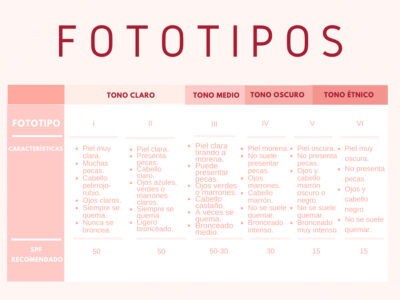
Knowing the skin phototype we have allows us to verify the SPF or Sun Protection Factor that we should look for..
The SPF is a multiplying factor of the exposure time that our skin can be exposed to UVB radiation from the sun without any protection.. Thus, an SPF sunscreen 50 multiply by 50 how long our skin tolerates this type of radiation.
But SPF is not the only characteristic that we must take into account to choose the most suitable sunscreen for our skin..
The cosmetic market offers a wide range of sunscreens that are increasingly more complete with respect to the different types of radiation.. In many cases, The labeling tells us that they also protect us from UVA radiation.. According to the regulations, so that a sunscreen protects us from UVA radiation, The initials PA must appear followed by the sign +. The more signs + appear next to the acronym, the greater your UVA protection. Another way to indicate protection against UVA radiation is when it is mentioned within a circle..

A complete sunscreen should also protect us from visible and infrared light radiation.. This is usually expressed in the labeling as Full Light Technology..
But this doesn't end here.
We can also choose a waterproof sunscreen. This is expressed on the label as water-resistant and tells us that after a dive of 40 minutes left 70% of SPF value.
Besides, If we want extra protection, There are protectors that are sweat resistant, which is indicated by the expression sweatproof o rubproof, and they are ideal for athletes. There are also sunscreens that contain tanning accelerators., that is to say, that contain ingredients that promote the production of melanin. And there are protectors that contain anti-aging substances., as antioxidants or skin lighteners.
In the end, variety.
Since sunscreens do not protect us from radiation 100%, It is prohibited for expressions such as “total protection” or “total screen” to appear on its labeling..
What else should I take into account when choosing my sunscreen??
We usually use different sunscreens for the face and body.. And although it is not essential, We must be aware that the skin of the face is more exposed to many other factors in addition to radiation, such as pollution or the use of makeup.
This area requires more attention and a little special care.. For this, We must take into account the state of the skin on our face and one of the things we usually pay attention to in this section is the tendency to generate more or less fat.. In this case, The cosmetic sector offers sun protection for oily skin that tends to have a lighter texture, are called oil-free.
Another characteristic to take into account may be the smell., if you are a lover of good aromas.
Besides, there are tinted sunscreens, simulating the use of a two in one: sunscreen and makeup base.
And already set, we can also choose the format. A spray, recommended for the body, although you have to keep in mind to use solar without nanoparticles. And stick formats, that can be good for the eye contour, for the lips and for other more specific areas such as those with tattoos.
How to use sun protection?
If using a physical or chemical sunscreen, We must apply said preparation to all areas of the body. According to dermatologists, it is recommended to apply some 2 milliliters of protective cream for each 2 square centimeters of skin. So that we have a reference, in the case of areas such as the face, The appropriate amount to apply can be determined using a line of sunscreen on the index and middle fingers as a measure.. In the following image you can see it better.

Nevertheless, even if we use a sunscreen with an SPF appropriate to our skin phototype and apply the correct amount, Experts recommend replenishing sun protection at most every 2 hours to prolong its effect over time, as it may lose effectiveness due to sweat, to the water, when the skin rubs against clothing, etc.
What other recommendations should we take into account to avoid sun damage??
In addition to using sun protection, A series of guidelines are recommended:
- Don't stay in the sun too much.
- Avoid sun exposure between 12 and the 16 hours.
- Do not expose minors to the sun 3 years and if you cannot avoid it, use sunscreen for babies.
- Use sunscreen even on cloudy days.
- If there is any change in spots or moles, go to a specialist.
- Protect skin and eyes by wearing clothing and glasses.
- Use extreme caution in the most sensitive areas.
Sun protection and makeup.
Facial sun protection should be incorporated as the final step of our cosmetic routine and prior to applying makeup.. Every day of the year.
There are creams with built-in sun protection. I do not usually recommend this format of cream since we must be aware that the function of a cream is to be absorbed by the skin to generate a benefit while sun protection is not absorbed., But it is a product that must be deposited on the skin like a film to protect it.. But it is preferable to use a cream with sun protection than not to use anything at all..
Once made up, It is important to replace said protection. For this, there are multiple products on the market in powder or spray format that allow replacement without modifying the finish of the makeup.. Here I leave you one from La Roche-Posay that I usually recommend and you may find interesting.
We should also use sunscreen even if we do not leave the house., since we are currently constantly exposed to the blue light emitted by electronic devices and this fact can also damage our skin.
Sun protection and vitamin D absorption.
If we use sun protection, can we have problems absorbing vitamin D?? This is a recurring question.. Sun protection does not completely prevent our skin from being exposed to the sun., so any type of filter would not be a problem for the absorption of this vitamin. Nevertheless, There are medical professionals who recommend sunbathing daily during low-intensity hours during 10-15 minutes to promote the absorption of vitamin D.
Natural and ecological sun protection.
There is an increasing trend for sunscreens to be made up of ingredients of natural origin, preferably vegan and above all that respect the biodiversity of the oceans.
You already know that some ingredients used in cosmetics can be fatal for marine fauna and flora.. To give you an idea, It is estimated that every year, 14.000 tons of sunscreen end up in the oceans. It is estimated that almost 80% of Caribbean corals have disappeared in recent 50 years due to chemical contamination, between them, those from cosmetic products.
Besides, The presence of nanoparticles in sunscreens also ends up in the water and are ingested by fish, which can enter the food chain, causing these nanoparticles to end up in our bloodstream, causing the aforementioned damage..
The use of this type of protectors that provide natural and ecological value is an extra, since we not only take care of ourselves, we also take care of the planet. Yes indeed, We must make sure that they are safe for our skin and that they protect us from the entire spectrum of radiation mentioned.
The cosmetic industry is advancing more and more in this field and offers us products that are increasingly aware of the environment and health..
Homemade sun protection
One of the cosmetic products that I least recommend using at home, are sunscreens. If we want to protect ourselves without using chemicals, I propose as an alternative to use clothes made with fabrics with sun protection., sunglasses, hats or caps, avoid the hours of greatest sun exposure and use umbrellas.
On the internet you can find millions of “recipes” to make sunscreen but with what you already know after reading this publication, Do you think it is easy to make a safe sunscreen at home??
If you don't know what state your skin is in, you want to know what cosmetics suit you or you need to change your beauty routine, reserve one of my Rutinas Beauty and we get to work.